



Montana launched a new pathway for experimental treatments that have completed Phase 1 but are not yet FDA-approved for general use.
What’s new about it?
For the first time, all patients are eligible - not just the terminally ill. And biotechs can charge money for it, where they could only cover costs before.
But Montana is not a free-for-all. It offers significantly more liberties, but comes with a tightly regulated pathway with licensing, oversight and reporting requirements.
Here is how it works.
In 2025, Montana passed Senate Bill 535, creating a framework for experimental treatments to move from biotech developers into clinical use through licensed Experimental Treatment Centers, or ETCs.

At a high level, the pathway looks like this:
1. The treatment has to be eligible.
Montana’s framework covers investigational drugs, biologics, medical devices, and other treatments that meet the requirements set out in the law.
Completing Phase 1 is an important part of that, but it’s not the only requirement. There are additional criteria around the treatment’s investigational status and safety evidence.
2. The treatment protocol goes through independent review.
Before an Experimental Treatment Center (ETC) can offer a treatment protocol, it has to go through an Experimental Treatment Review Board (ETRB).
The ETRB reviews the safety evidence behind the treatment, the proposed protocol, informed consent, monitoring plans, and other safeguards.
The important distinction here is that ETRB approval is not FDA approval, and it isn’t a determination that a treatment works. The Board’s role is to independently review whether the protocol meets the safety, informed-consent, and other requirements of Montana’s framework.
3. Treatment happens through a licensed ETC.
The ETRB reviews treatment protocols. It doesn’t treat patients.
That happens through an Experimental Treatment Center, a healthcare facility licensed by Montana’s Department of Public Health and Human Services (DPHHS).
The ETC is where the clinical side comes in: medical oversight, patient care, administration of the treatment, monitoring, and reporting.
4. The patient and treating provider make the individual decision.
An approved protocol doesn’t mean a patient is automatically cleared to receive it.
The treating provider still has to determine that the individual patient meets the requirements, recommend the treatment, and go through the informed-consent process with them.
So, stripped down to the basic map:
Eligible treatment → ETRB review → Licensed ETC → Patient access
What Does Infinita Do?
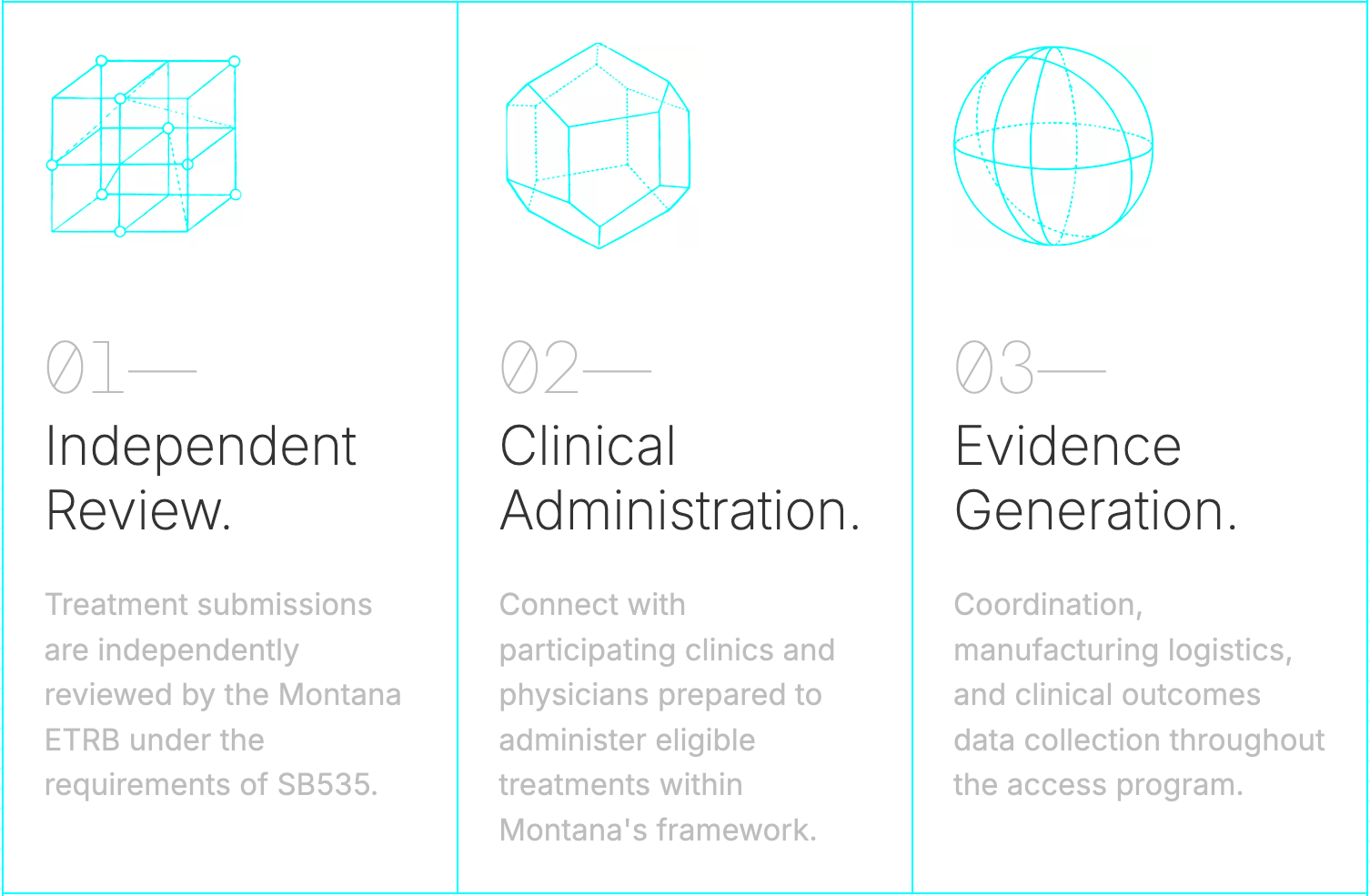
Infinita is building a network of biotechs and clinics to use SB535, and it formed an independent ETRB.
The roles remain separate: Infinita helps biotechs navigate the process, the ETRB independently reviews treatment protocols, and licensed ETCs and treating providers are responsible for clinical care.
Will there be an online directory listing the available treatments, and the clinics delivering them?